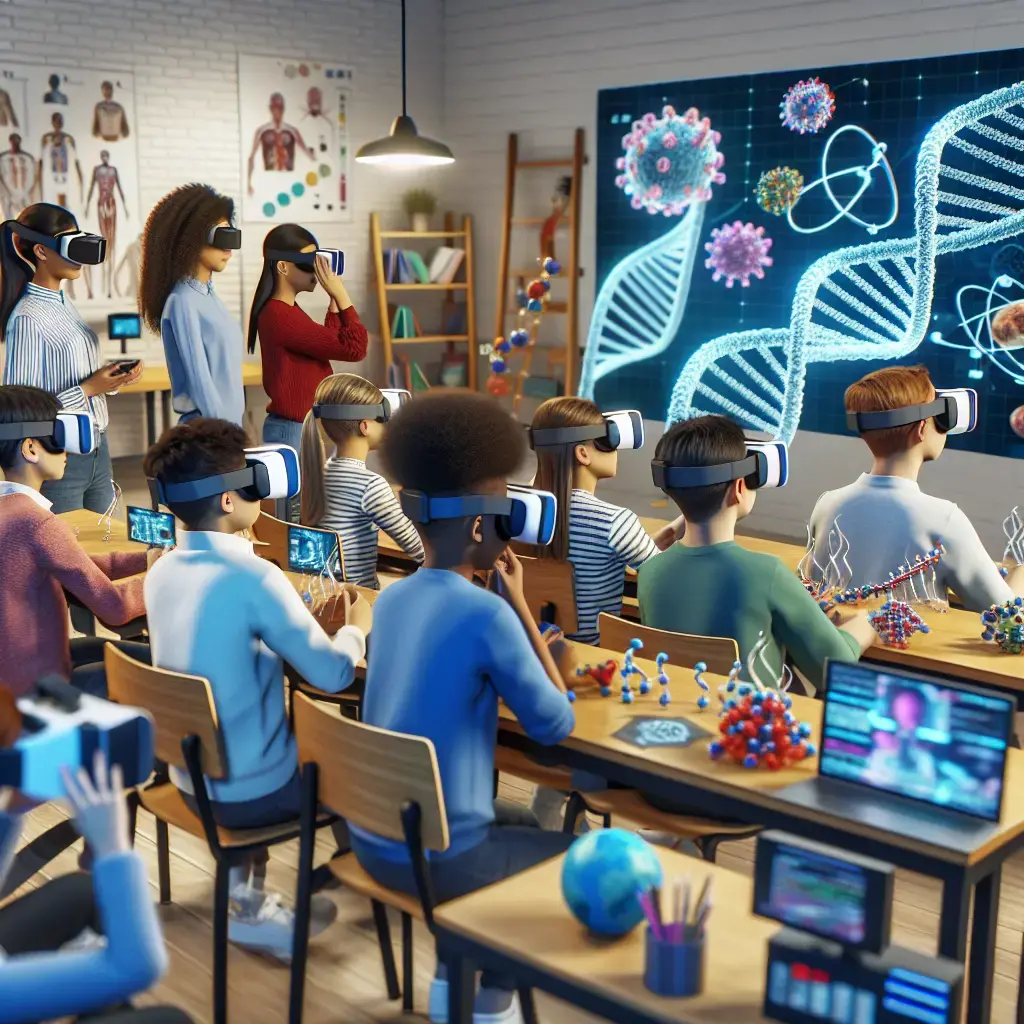
Transforming STEM Education with Virtual Reality
In the rapidly evolving landscape of education, virtual reality (VR) technology is emerging as a game-changer, particularly in STEM education. As educators and students seek more engaging and effective ways to explore complex subjects, VR is stepping into the spotlight as an indispensable tool for STEM learning. The integration of virtual reality in STEM education is not just a trend; it's a transformation that redefines how students interact with scientific concepts, engineering principles, and mathematical theories.
In the dynamic world of education, virtual reality is proving to be a pivotal force, especially in STEM education. This cutting-edge technology is not merely a passing trend but a revolutionary tool that enhances the educational experience by immersing students in interactive and engaging learning environments. This transformation is reshaping how students understand complex scientific concepts, engineering principles, and mathematical theories.
The Rise of VR in STEM Learning
Virtual reality technology in education is redefining traditional teaching methods by providing immersive learning experiences that captivate students' attention. The allure of VR educational tools lies in their ability to transform abstract concepts into tangible experiences. For instance, students at Hong Kong Polytechnic University have developed a VR device to improve productivity for individuals with ADHD. Such innovations illustrate how VR in STEM education can address diverse learning needs, promoting inclusivity and engagement.
A recent project showcased by Dezeen's School Shows highlighted students at Arts University Bournemouth using VR to enhance their design and architecture projects. One project included a wellness center that integrates virtual reality applications, demonstrating the potential of VR educational experiences to blend theoretical knowledge with practical application. These examples underscore the transformative power of VR classroom applications across various disciplines.
Immersive Learning in Science Education
Virtual reality for science education allows students to explore scientific phenomena in a risk-free, controlled environment. Imagine being able to conduct chemical experiments without the constraints of a traditional lab setting. This capability is further exemplified by NASA's simulated Mars mission within HERA, where VR is employed to mimic extraterrestrial environments for research volunteers. Such applications highlight how immersive learning in STEM can simulate real-world conditions, preparing students for future scientific endeavors.
NASA's RockSat-X mission also serves as a testament to the integration of VR in STEM learning. By sending student-developed experiments to space, this initiative provides a practical, hands-on experience that complements virtual simulations, illustrating the symbiotic relationship between VR technology and experiential learning.
Revolutionizing Math and Engineering Education
In mathematics, virtual reality math learning transforms abstract numbers and formulas into interactive experiences. By visualizing complex equations and geometrical shapes in three dimensions, students can better grasp intricate mathematical concepts. This innovative approach addresses different learning styles and enhances comprehension and retention.
For engineering education, VR offers the ability to simulate complex systems and structures, allowing students to engage with real-world challenges. The benefits of VR in STEM are evident as students can virtually construct and test engineering marvels, fostering problem-solving skills and critical thinking. This transformation is well-documented in various educational institutions that have incorporated VR engineering education into their curriculum.
Enhancing STEM Curriculum with Virtual Reality
The integration of virtual reality teaching methods into the STEM curriculum enhances educational experiences by catering to diverse learning styles. AI-powered solutions are also emerging as complementary tools, addressing special education needs and creating inclusive learning environments. Custom AI solutions, as discussed by TeachThought, illustrate how technology can adapt to individual learning profiles, ensuring all students can excel.
Moreover, the ongoing MHESI Fair 2024 in Thailand showcases the convergence of AI, robotics, and virtual reality technologies, highlighting the interdisciplinary potential of these advancements in reshaping future STEM curriculum enhancement with VR.
The Future of STEM Education with Virtual Reality
As we look towards the future, the role of VR in STEM education promises to expand even further. The ongoing advancements in AI and machine learning are poised to revolutionize design and creativity within educational contexts. With new technology enabling the creation of erasable 3D images, as reported by recent technological breakthroughs, students can now visualize anatomical structures or mechanical systems like never before.
Furthermore, events like Montgomery's Civil Rights March in the Metaverse illustrate how virtual environments can facilitate global participation and engagement, expanding educational opportunities beyond traditional boundaries.
Conclusion
Virtual reality technology in education is a catalyst for STEM education transformation. By providing immersive, interactive experiences, VR educational tools are making science more accessible and engaging for students worldwide. As we continue to explore the myriad ways this technology is implemented across disciplines, it's clear that the future of STEM education with virtual reality holds limitless possibilities.
For educators and professionals interested in integrating these tools into their teaching methodologies, staying informed on the latest developments is crucial. By embracing these innovations, we can ensure that our educational practices evolve alongside technological advancements, paving the way for a future where learning is as boundless as our imaginations.
We invite you to share your thoughts, experiences, or insights on the impact of virtual reality in education. How do you envision VR transforming classrooms of the future? Engage with us in the comments below!
Author: Oliver Chandler